
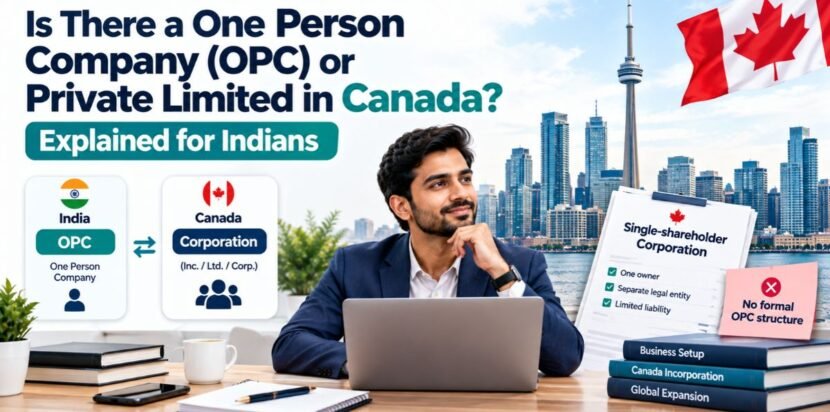
“Mujhe Canada mein OPC register karni hai.” or “Canada mein Pvt Ltd company kaise banegi?” These are some of the most common enquiries our Surrey office receives from India. The intent is perfectly clear: a solo founder wants a limited-liability company abroad. The problem is only the vocabulary. Canada does not use these terms, and some online providers sell “Canada OPC” packages that simply do not exist as a separate Canadian corporate structure.
This guide translates Indian company types into their Canadian equivalents, explains how one person can own and run a Canadian company alone, and clears up what Inc., Ltd., and Corp. really mean.
In This Guide
-
- Is There a One Person Company in Canada?
-
- Can One Person Be Director and Shareholder in Canada?
-
- Is There a Private Limited Company in Canada?
-
- Inc. vs Ltd. vs Corp.: What Do They Mean?
-
- Indian Business Types and Their Canadian Equivalents
-
- Why the Canadian Corporation Is Usually Simpler Than an Indian OPC
-
- Common Mistakes Indian Founders Make With Canadian Company Types
-
- Which Should a Solo Indian Founder Register?
-
- FAQs
Is There a One Person Company in Canada?
No. The One Person Company is a structure created by India’s Companies Act, 2013, with Indian-specific features like a mandatory nominee. Canadian corporate statutes, including the federal Canada Business Corporations Act and each province’s own legislation, do not have a separate OPC category.
They do not need one. In Canada, an ordinary corporation can be formed by a single individual from day one. That single-shareholder, single-director corporation is the practical equivalent of an Indian OPC, and in many ways it is simpler.
Can One Person Be Director and Shareholder in Canada?
Yes. A Canadian corporation can have just one shareholder who is also the only director and holds every officer role, such as president or secretary, where permitted. There is no general requirement for a second person, no nominee requirement, and no minimum paid-up capital. Many founders issue a nominal number of shares at a nominal price at incorporation.
The one condition to watch is director residency. Provinces such as Ontario and British Columbia do not require any director to be a Canadian resident, so an Indian living in India can generally be the sole director. A federal corporation, however, generally requires at least 25% of its directors to be resident Canadians. With a single director, that means the director must be a Canadian resident. That is why many solo Indian founders consider provincial incorporation. We explain the trade-off in our guide to federal or provincial incorporation.
| Feature | India: OPC | Canada: Single-Shareholder Corporation |
|---|---|---|
| Minimum Shareholders | 1 | 1 |
| Minimum Directors | 1 | 1 |
| Nominee Required | Yes | No |
| Resident Director | Indian citizen and resident requirements apply | None in Ontario or BC; federal residency requirements apply |
| Minimum Capital | No general minimum paid-up capital requirement | No general minimum capital requirement |
| Who Can Form It | Eligible natural person under Indian law | Individuals or companies, subject to applicable laws |
| Name Ending | OPC Private Limited | Inc., Ltd., or Corp., or the full forms |
Is There a Private Limited Company in Canada?
Not by that name. An Indian Private Limited Company is a closely held company with restrictions on share transfers and no public offering. In Canada, many small business corporations are privately held, with restrictions on share transfers and without offering shares to the public. Federal law uses the term “non-distributing corporation” in relevant contexts, but in everyday use, it is generally just called a corporation.
So if you want a “Pvt Ltd in Canada”, what you actually register is a standard corporation, with the appropriate provisions in its articles. You cannot simply add “Pvt Ltd” or “Private Limited” to the name as you would in India. Canada uses its own recognised legal endings.
Inc. vs Ltd. vs Corp.: What Do They Mean?
Every Canadian corporation’s name must include a recognised legal element. Common English options are Limited (Ltd.), Incorporated (Inc.), and Corporation (Corp.), with French equivalents such as Limitée (Ltée) and Incorporée.
Generally, there is no difference in the basic legal status or limited-liability protection solely because a corporation uses Inc., Ltd., or Corp. The appropriate tax treatment depends on the corporation’s circumstances and applicable tax rules, not simply on the name ending.
Practical tips: “Inc.” is common and reads well to US and Canadian clients. “Ltd.” may feel familiar to Indian and British audiences. Whichever you choose, use it consistently on invoices, contracts, and your bank account, because the full legal name, including the ending, is what counts. Before filing a named company, you may need a NUANS name search or another applicable name search, depending on the jurisdiction.
You can also skip a custom name and register a numbered company, such as “1234567 Ontario Inc.”, then operate under a business name later. This can simplify the naming process if you need an entity quickly.
Indian Business Types and Their Canadian Equivalents
| India | Closest Canadian Equivalent | Notes |
|---|---|---|
| Sole Proprietorship | Sole Proprietorship | No separate legal entity; may be impractical for a non-resident depending on the business and registration requirements |
| Partnership Firm | General Partnership | Partners may be personally liable |
| LLP | LLP or Limited Partnership | Availability and eligibility vary by province; LLPs may be restricted to certain professions |
| One Person Company | Corporation with One Shareholder and Director | No nominee and no separate OPC label |
| Private Limited Company | Private Corporation | Standard structure for many small businesses |
| Public Limited Company | Public Corporation or Reporting Issuer | Securities laws may apply |
| Section 8 Company | Not-for-Profit Corporation | Governed by separate legal requirements |
| Subsidiary of Indian Company | Canadian Subsidiary Corporation | The Indian company is the shareholder |
| Branch Office | Extra-Provincial Registration of the Indian Company | The Indian company itself carries on business in Canada |
Two Canadian-only structures you may hear about are the Unlimited Liability Company (ULC), available in certain provinces and used in some cross-border tax planning arrangements, and the professional corporation, used by certain regulated professionals such as doctors and accountants. Neither is usually the right starting point for a typical Indian founder.
Why the Canadian Corporation Is Usually Simpler Than an Indian OPC
Indian founders are often surprised by how straightforward the Canadian corporate structure can be compared with India:
- No nominee: You do not need to name a successor at incorporation.
- No second director: One director can be enough, subject to the applicable jurisdiction’s rules.
- Open to foreign owners: Individuals of any nationality can generally own shares, subject to applicable laws and director residency rules.
- Fewer Indian-style statutory forms: There is no equivalent of India’s DIN, DSC, or SPICe+ process, but you must maintain proper corporate records and a minute book.
“Simpler to form” does not mean “nothing to do”. The company still needs to file an annual return, a T2 corporate tax return every year, and GST/HST returns if registered. Because you are investing from India, your Indian side may also have reporting and compliance obligations under FEMA’s Overseas Direct Investment rules.
Talk to DKP Global: India + Canada, One Team
Offices in Gurugram and Surrey, BC. Canadian incorporation, CRA registrations, bookkeeping, and India-side ODI/FEMA compliance handled together.
India: +91-9990424342
Canada: +1-672-833-4342
Email: info@dkpglobal.orgCanada Company Registration Services:
/company-registration-canada/
Common Mistakes Indian Founders Make With Canadian Company Types
Most problems we fix for Indian founders come from importing Indian assumptions into Canada. These are the ones we see most often.
- Buying a “Canada OPC” package: If a provider sells you an OPC in Canada, ask exactly which statute the entity is formed under. You will generally end up with an ordinary corporation, and a federal corporation may not be suitable for a solo non-resident director.
- Choosing federal incorporation for prestige: Federal names can feel more national, but the director residency rules may make federal incorporation unsuitable for a solo founder living in India.
- Writing “Pvt Ltd” on invoices: Your invoices, contracts, and bank account should show the exact registered name, including its legal ending. A mismatch can hold up bank onboarding and client payments.
- Skipping the minute book: India’s MCA filings record much of a company’s history publicly. In Canada, you are expected to maintain corporate records, including resolutions, registers of directors and shareholders, and share records. Our guide to the corporate minute book explains what goes in it.
- Ignoring the India side: Investing share capital in a Canadian company may qualify as Overseas Direct Investment. Applicable reporting and remittance requirements should be addressed through your Authorised Dealer bank.
None of these mistakes is necessarily difficult to avoid, but each can be expensive to correct later. A short discussion about the right structure before filing can save considerable time and expense.
Which Should a Solo Indian Founder Register?
For many solo founders living in India, a practical option is one corporation, one shareholder (you), and one director (you), incorporated in a province that does not require a resident director, such as Ontario or British Columbia. Choose a name with “Inc.” or “Ltd.”, or start with a numbered company if speed matters.
If you already own an Indian Private Limited Company and want the Canadian company to belong to it, the Indian company can become the shareholder instead of you personally. That changes the ODI reporting on the Indian side and may affect the tax position in both countries, so plan it before filing.
Not sure whether you need a company at all yet? Our comparison of sole proprietorship vs corporation walks through that decision.
Frequently Asked Questions
No. The OPC is an Indian structure. In Canada, an ordinary corporation can have one shareholder and one director, which is the practical equivalent.
Not by that name. You register a standard privately held corporation, which can serve a similar purpose to an Indian Pvt Ltd. The name generally ends in Inc., Ltd., or Corp.
Yes. One individual can be the only shareholder, director, and officer, subject to applicable corporate requirements. For a non-resident, a province such as Ontario or BC may be suitable because it does not generally require a resident Canadian director.
There is generally no difference in basic corporate status or limited-liability protection based solely on the ending. All three are recognised legal elements: Incorporated, Limited, and Corporation.
No. Canadian corporate names must use a recognised legal element, such as Inc., Ltd., or Corp., depending on the jurisdiction.
No. Canadian corporations do not have the same general nominee requirement as an Indian OPC.
There is generally no minimum paid-up capital requirement for an ordinary Canadian corporation. Shares may be issued for a nominal amount, subject to the company’s articles and applicable rules.
A numbered company is a corporation registered with a number as its legal name, such as 1234567 Ontario Inc. It can simplify the naming process and may operate under a registered business name later.
Yes. An Indian company can generally be the sole shareholder of a Canadian subsidiary, subject to applicable Canadian requirements and Indian ODI reporting and compliance rules.
Final Word
Canada does not have an OPC or a Private Limited Company under those Indian legal names, and you do not need either to establish a one-person business. A single-shareholder Canadian corporation can provide limited liability and a straightforward ownership structure, provided you choose the right jurisdiction and meet its requirements.
DKP Global’s Surrey team assists Indian founders with Canadian incorporation, while our Gurugram team supports India-side ODI compliance. Start with our Canada company registration services.
Summary
- No OPC or “Pvt Ltd” in Canada: These are Indian legal terms.
- Practical equivalent: A corporation with one shareholder and one director, generally without a nominee requirement or minimum capital requirement.
- Inc. = Ltd. = Corp. in basic corporate status: Choose the legal ending permitted by the jurisdiction and use it consistently.
- Solo founder living in India: Ontario or BC may be suitable because these provinces generally do not require a resident Canadian director. Federal incorporation has separate residency requirements.
- Indian compliance: ODI reporting under FEMA may apply.
Call: +91-9990424342 (India) | +1-672-833-4342 (Canada) | info@dkpglobal.org
Implementation Notes for WordPress
Content Type
WordPress Post (Blog), not a Page.
Schema to Add
- Article or BlogPosting schema
- FAQPage schema for the 10 FAQs above
Internal Links
- Link to
/company-registration-canada/from the mid-article CTA and conclusion. - Link to the federal or provincial incorporation guide in the director residency section.
- Link to the corporate minute book guide in the common mistakes section.
- Link to the sole proprietorship vs corporation guide in the solo founder section.
Legal and Compliance Note
Corporate naming rules, director residency requirements, incorporation eligibility, and Indian ODI requirements depend on jurisdiction and circumstances. Verify the relevant federal or provincial rules and obtain professional advice before publication or incorporation.
AEO and AI Overview Optimisation
The direct answer, comparison table, scenario-based explanation, and concise FAQs are structured to help readers find answers to common questions about Canadian corporate structures for Indian founders.
Plagiarism and AI Detection
The content has been edited for clarity and readability. Run the final version through a plagiarism checker before publishing.