
Spices from Kerala, basmati from Punjab, textiles from Tiruppur, handicrafts from Jaipur, generics from Hyderabad there is real Canadian demand for Indian products, driven partly by one of the largest Indian diasporas in the world. Bilateral trade was about CAD 30 billion in 2025, and both governments are negotiating a trade agreement aiming to grow it sharply.
But importing into Canada in 2026 is not what it was even two years ago. The CBSA’s new CARM system has moved responsibility squarely onto importers, and Indian goods do not enjoy the preferential duty many people assume. This guide explains how to structure an India–Canada import-export business, every registration you need on both sides, and the costs and rules that catch first-time importers.
In this guide
- 1. How to Structure Your India–Canada Trading Business
- 2. Do You Need an Import-Export Licence in Canada?
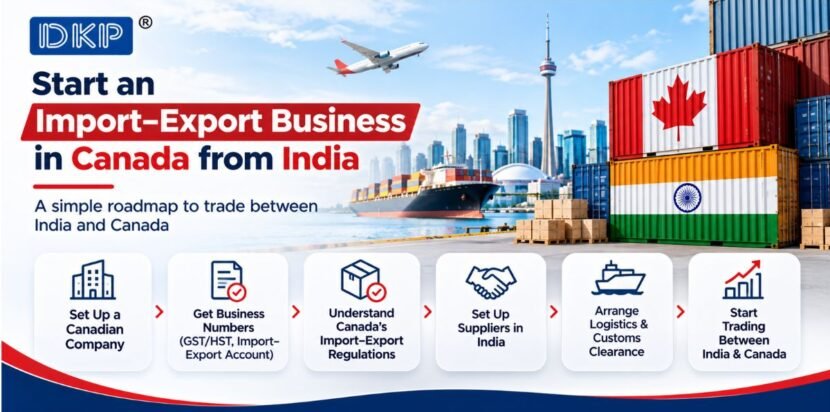
- 3. Step-by-Step Setup in Canada
- 4. CARM: The 2026 Reality for Importers
- 5. Duties and Taxes on Indian Goods
- 6. A Worked Example: Importing Spices From Kerala
- 7. Pricing When You Buy From Your Own Indian Company
- 8. Exporting From Canada (Including to India)
- 9. The India Side: What Your Exporter Needs
- 10. Common Mistakes New Importers Make
- 11. FAQs
How to Structure Your India–Canada Trading Business
| Structure | How it works | Best for |
| Canadian corporation as importer | Your Canadian company buys from India, imports, holds stock and sells in Canada | Most founders clean local entity, local banking and customers |
| Canadian subsidiary of your Indian company | Indian exporter owns the Canadian importer/distributor | Established Indian exporters expanding distribution |
| Indian company as non-resident importer | Indian company itself registers with CBSA and imports, selling to Canadian customers | Limited volumes; requires full Canadian customs and GST setup anyway |
| Sell to a Canadian importer | You export from India; a Canadian buyer imports | Testing the market with no Canadian entity |
A non-resident importer still needs a Business Number, an RM account, CARM registration, financial security and GST/HST registration so for ongoing trade, most clients find a Canadian corporation simpler to bank, insure and sell through. If your Indian company will own it, see our guide on subsidiary vs branch.
Do You Need an Import-Export Licence in Canada?
There is no single general “import licence” in Canada. What you need is an import-export program account with the CRA, the RM account attached to your Business Number plus registration with the CBSA. On top of that, specific products need permits or licences from the regulator responsible for them:
| Product | Regulator/requirement (examples) |
| Food (spices, rice, snacks, sweets) | CFIA Safe Food for Canadians (SFC) licence for importers; labelling and food safety rules |
| Cosmetics, ayurvedic and natural health products | Health Canada cosmetic notification or natural health product licensing |
| Drugs and medical devices | Health Canada establishment licences and product approvals |
| Textiles and apparel | Labelling rules (fibre content, dealer identity) |
| Plants, seeds, wood products | CFIA plant health import requirements |
| Controlled or restricted goods | Global Affairs Canada import permits |
Check product rules before your first shipment. A container of spices held at the border because the importer had no SFC licence is an expensive way to learn.
Step-by-Step Setup in Canada
| Step | What you do |
| 1. Incorporate | Set up your Canadian corporation in the province where you will warehouse or sell |
| 2. Business Number + accounts | Register the BN with CRA and add the RM (import-export) program account and GST/HST account |
| 3. CARM Client Portal | Create the business account in the CBSA’s CARM Client Portal and link the RM account |
| 4. Financial security | Post an e-bond or cash security to use Release Prior to Payment (RPP) |
| 5. Appoint a customs broker | Delegate authority in the CARM portal to a licensed customs broker |
| 6. Product permits | Obtain CFIA, Health Canada or other licences your products need |
| 7. Bank account and payments | Open a Canadian business account; set up supplier payments to India |
| 8. Warehouse and logistics | Arrange freight forwarder, warehouse or 3PL, insurance |
| 9. Bookkeeping and filings | Track landed cost, duties, GST paid at the border and inventory from day one |
| Talk to DKP Global — India + Canada, One Team Offices in Gurugram and Surrey, BC. Canadian incorporation, CRA registrations, bookkeeping and India-side ODI/FEMA compliance handled together. India: +91-9990424342 Canada: +1-672-833-4342 Email: info@dkpglobal.org → Canada company registration services: | |
CARM: The 2026 Reality for Importers
The CBSA Assessment and Revenue Management system, CARM, is now how commercial imports are accounted for and paid. The changes that matter most for a new importer:
- You are liable. From 1 January 2026, the importer of record is liable for duties and taxes. The old practice of clearing goods under a customs broker’s own account and bond has ended for commercial goods.
- You need your own security to get goods released before paying the Release Prior to Payment (RPP) program. Security can be an e-bond (covering 50% of the requirement, minimum CAD 5,000 per RM account) or a cash deposit (100%). The amount is reviewed periodically against your import activity.
- Delegation does not transfer liability. You authorise your customs broker in the portal, but you remain responsible.
- Deadlines are strict. Accounting documents and monthly payments have fixed timelines; repeated late payments can cost you RPP eligibility.
- Non-resident importers face the same rules as Canadian ones.
In practice, budget for the security and choose a broker who will walk you through CARM setup before your first container ships.
Duties and Taxes on Indian Goods
Here is the point many guides get wrong. Canada offers lower duty rates to some developing countries under its General Preferential Tariff (GPT). India is not on the GPT beneficiary list. So most goods from India are charged Canada’s standard Most-Favoured-Nation (MFN) rates, which depend on the product’s tariff classification; many goods are duty-free, while others, such as some apparel and food items, carry significant duty.
| Cost at the border | Notes |
| Customs duty | MFN rate by HS classification; correct classification is critical |
| GST | 5% on the duty-paid value; registered businesses generally recover it as input tax credits |
| Excise or other levies | Apply to specific goods only |
| Broker fees | Per entry, plus monthly or account fees |
| Freight, insurance, storage | Part of your landed cost, not tax |
Both governments are negotiating a Comprehensive Economic Partnership Agreement (CEPA), with talks in late 2026 aiming to conclude by year-end. Until an agreement is signed and in force, plan your pricing on MFN rates. If CEPA comes into force, preferential rates will depend on its rules of origin.
A Worked Example: Importing Spices From Kerala
Say a founder in Kochi sets up an Ontario corporation to import packaged spices and sell them to Indian grocery stores in Brampton and Mississauga. Before the first order, the Canadian company registers its Business Number with RM and GST/HST accounts, sets up its CARM business account, posts an e-bond for Release Prior to Payment and delegates authority to a customs broker in Toronto.
Because spices are food, the company also obtains a CFIA Safe Food for Canadians licence, prepares a preventive control plan, and checks that every pack carries bilingual labels with the right nutrition and importer information. In India, the supplier holds an IEC, exports under a LUT without IGST, and issues a commercial invoice to the Canadian company at a price both sides can defend as arm’s length.
When the container lands, the broker classifies the goods, the CBSA releases them against the RPP security, and the company later pays MFN duty if any applies to that classification plus 5% GST through its monthly CARM statement. The GST is recovered as an input tax credit on its next GST/HST return, and the duty becomes part of the landed cost used to price the spices. None of this is difficult, but every step has to be in place before the ship leaves Kochi.
Pricing When You Buy From Your Own Indian Company
If your Canadian company buys from an Indian company you or your family own, two rules meet. Customs values imports generally on the price paid, and related-party prices can be examined to ensure the relationship did not influence them. Income tax transfer pricing rules in both Canada and India require the price to be at arm’s length. Setting the price too low to save duty raises Canadian profit and may trigger Indian transfer pricing adjustments; setting it too high shifts profit to India and may be challenged by the CRA. Set a documented, defensible price from the first invoice.
Exporting From Canada (Including to India)
If your Canadian company exports goods back to India or elsewhere, most commercial exports to destinations other than the United States must be reported electronically through the CBSA’s export reporting system once they exceed the reporting threshold, and some goods need export permits. Exports are generally zero-rated for GST/HST, so you charge no Canadian sales tax but can still claim input tax credits. The Indian buyer handles Indian import duties and must hold an IEC.
The India Side: What Your Exporter Needs
- IEC (Importer Exporter Code) from DGFT — mandatory for exporting goods from India.
- GST and LUT — exports of goods are zero-rated; filing a LUT allows export without paying IGST.
- Export documentation — commercial invoice, packing list, shipping bill, certificate of origin where useful.
- Product rules — some goods need export registration or inspection (for example, through export promotion councils or commodity boards).
- Payment realisation — export proceeds must be realised and repatriated within the period prescribed by RBI.
- ODI — if you or your Indian company own the Canadian importer, the investment is reportable under India’s ODI rules. See our ODI rules guide.
Common Mistakes New Importers Make
- Assuming Indian goods get preferential (GPT) duty rates.
- Shipping before CARM registration and RPP security are in place.
- Ignoring CFIA or Health Canada requirements for food, cosmetics, or Ayurvedic products.
- Misclassifying products to get a lower duty rate; penalties and reassessments follow.
- Not tracking GST paid at the border, losing input tax credits.
- Related-party pricing with no transfer pricing documentation.
- Mixing personal and company payments to Indian suppliers, creating FEMA and tax problems.
Also Read- Canada company registration services
Also Read- CRA Business Number
Also Read- GST vs HST vs PST
Also Read- subsidiary vs branch
Also Read- Canadian business bank account
Also Read- ODI rules
Also Read- CBSA — CARM
Also Read- Finance Canada — tariff preference programs
Frequently Asked Questions
Set up a Canadian corporation, get a Business Number with an RM import-export account, register in the CBSA’s CARM Client Portal, post security for Release Before Payment, appoint a customs broker, and get any product-specific licences.
There is no general licence. You need a CRA import-export (RM) account and CBSA registration, plus product-specific permits for regulated goods such as food or health products.
No. India is not a beneficiary of Canada’s General Preferential Tariff, so Indian goods generally pay standard MFN rates.
The CBSA Assessment and Revenue Management system, through which importers register, account for imports and pay duties and taxes.
To use Release Prior to Payment, yes — an e-bond covering 50% of the requirement (minimum CAD 5,000) or a cash deposit.
Yes, as a non-resident importer, but it must meet the same CBSA, CARM and GST requirements. Most ongoing businesses find a Canadian corporation simpler.