
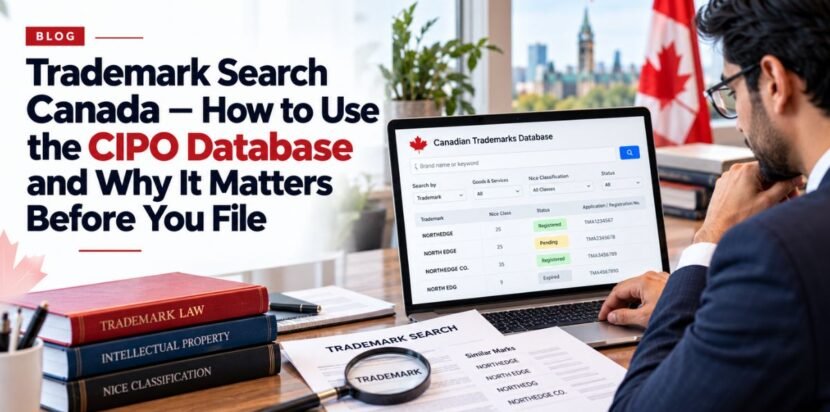
| A trademark search in Canada involves searching the CIPO Trademarks Database at cipo.ic.gc.ca, plus common law sources (provincial business registries, Google, domain names, social media) to check whether a confusingly similar mark already exists. The CIPO database is publicly searchable and free you can search by word mark, phonetic equivalent, design element, or Nice Classification class. However, a CIPO database search alone is not sufficient for trademark clearance — common law marks (unregistered trademarks in use in Canada) can also block your application or be used to oppose your registration in the Trademarks Journal opposition period. A comprehensive trademark clearance search (CIPO + common law + provincial + domain + WIPO international) should be conducted before every CIPO trademark application, since CIPO government filing fees (CAD $458 for the first class) are non-refundable. DKP Global conducts full trademark clearance searches as part of every trademark application package contact us at +1-672-833-4342. |
Before you spend time, money, and energy filing a CIPO trademark application, there is one step that saves businesses from a very expensive mistake: the trademark search.
Every year, Canadian businesses file trademark applications without doing a proper search first — and every year, a significant portion of those applications are refused by the CIPO Examiner because a confusingly similar trademark was already registered. The CIPO government filing fee (CAD $458 for the first class) is non-refundable. A proper trademark clearance search costs far less than a refused application.
This guide explains how to search the CIPO trademark database, what a complete trademark clearance search covers, what “confusingly similar” actually means under Canadian law, and why you need more than just the CIPO database for adequate clearance.
What Is a Trademark Clearance Search?
A trademark clearance search is a multi-source review conducted before a CIPO trademark application is filed. Its purpose is to identify any existing trademarks — registered or unregistered — that could:
| Risk | Description |
| Block the application at examination | The CIPO Examiner cites an existing registered trademark as confusingly similar to the proposed mark and refuses the application; the applicant loses the filing fee and must choose between appealing, modifying the mark, or abandoning it |
| Lead to an opposition | The owner of an existing registered or unregistered trademark files a Statement of Opposition against the application during the 2-month Trademarks Journal advertisement period; this triggers formal opposition proceedings before the Trademarks Opposition Board |
| Lead to infringement liability after registration | Even a registered trademark can be challenged and cancelled if it is confusingly similar to an earlier unregistered mark with established common law rights — a registered trademark is not a guaranteed shield against a prior user with provable common law rights |
A clearance search reduces all three risks before money is spent on a CIPO application. It does not eliminate risk entirely — but it identifies the highest-risk conflicts and allows the applicant to make an informed decision before filing.
How to Search the CIPO Trademark Database
The CIPO Trademarks Database is publicly available and free to search at cipo.ic.gc.ca. It contains all Canadian trademark applications currently pending and all registered trademarks. Here is how to use it effectively:
Search Method 1: Word Mark Search
The most common search type. Enter the word or phrase you want to register in the search field and search for:
| Search Strategy | What to Search | Why |
| Exact match | The exact word(s) of your proposed mark | Finds identical registered marks immediately; if there is an exact match in the same Nice class, the application will very likely be refused |
| Phonetic equivalents | Words that sound the same as your mark but are spelled differently (e.g., “Kool” for “Cool”, “Phresh” for “Fresh”) | CIPO’s likelihood-of-confusion analysis is based on the SOUND of the marks, not just the spelling — phonetically identical marks in the same class are treated as confusingly similar |
| Truncated / root word search | The root of your proposed mark without suffixes or prefixes | Finds marks that share the same core word but with different endings or beginnings — these can still be found confusingly similar |
| Common misspellings | Known alternate spellings of your proposed mark | Marks that look different on paper but would commonly be said the same way are treated identically in the confusion analysis |
| Translation / transliteration | The English translation of any non-English word in your mark | CIPO considers the meaning of a foreign word — “SOLEIL” (French for “sun”) may be confusingly similar to “SUNSHINE” in the same class |
Search Method 2: Design Mark Search
If your proposed trademark includes a logo or visual design element, you need to search the CIPO design mark database using the Vienna Classification codes — an international classification system for graphic elements in trademarks. Every design element (a maple leaf, a lion, a geometric shape, a stylized letter) has a corresponding Vienna code, and the CIPO database is searchable by these codes.
Design searches are more complex than word searches because two designs may look visually similar without sharing any words. DKP Global conducts design searches using the appropriate Vienna Classification codes for every proposed design mark application.
Search Method 3: Nice Classification Search
You can also filter CIPO search results by Nice Classification class — the category of goods or services the trademark covers. Filtering by class is important because:
| Situation | What It Means for Your Search |
| Same mark, same Nice class | Almost certainly refused — identical or very similar marks registered in the same class for the same goods/services will block a new application |
| Same mark, related Nice class | Potentially problematic — CIPO’s confusion analysis looks at the relationship between the goods/services in the two marks; related goods/services in adjacent classes can still be found confusingly similar |
| Same mark, unrelated Nice class | Lower risk — a mark registered in Class 25 (clothing) does not block an identical mark in Class 36 (financial services) IF the goods/services are genuinely unrelated and consumers would not be confused about the source; however, a famous or well-known mark in any class may assert broader protection |
Why the CIPO Database Alone Is Not Enough
The CIPO trademark database shows registered trademarks and pending applications. It does NOT show:
| What CIPO Database Misses | Why It Matters | Where to Search |
| Unregistered common law trademarks | In Canada, trademark rights arise from USE — not just registration. A business that has been using a trademark in Canada for years, even without a CIPO registration, has common law trademark rights. These rights can form the basis of an opposition to your CIPO application even if there is no corresponding registration in the CIPO database. | Google, social media (Instagram, Facebook, LinkedIn, X/Twitter), industry directories, provincial business registries, review platforms (Yelp, Google Maps) |
| Provincial business name registrations | A business name registered with a provincial corporate registry (BC Registry, Ontario Business Registry, etc.) is NOT a trademark — but it demonstrates prior commercial use in that province, and its existence is relevant to the likelihood-of-confusion analysis | BC Registry, Ontario Business Registry, NUANS corporate name search, the business registry of every province where you operate or plan to operate |
| Domain names (.ca and .com) | A domain name registrant with an established website using the same or similar name as your proposed mark may have common law rights in that name — and could oppose your trademark application | CIRA WHOIS for .ca domains; domain registrars for .com; international ccTLD registries if operating in multiple countries |
| Social media presence | An established brand presence on Instagram, Facebook, LinkedIn, or TikTok using your proposed name can constitute evidence of prior use and common law rights in Canada | Platform search: Instagram, Facebook, LinkedIn, X (Twitter), TikTok, YouTube |
| WIPO Madrid Protocol designations | An international trademark registered under the Madrid Protocol and designating Canada has the same legal force as a CIPO registration — but may appear in the WIPO Global Brand Database before being fully reflected in the CIPO database | WIPO Global Brand Database: branddb.wipo.int |
| Pending CIPO applications not yet published | Very recent CIPO filings may not appear in search results immediately — there is a processing lag between filing and the application appearing in the public database | Important reason to file your own application as early as possible to establish your priority date |
What Does “Confusingly Similar” Mean Under Canadian Trademark Law?
The central question in CIPO trademark examination is whether the proposed mark is “confusingly similar” to an existing registered mark. CIPO Examiners apply the legal test from the Trademarks Act, which requires considering all surrounding circumstances including:
| Factor | What CIPO Considers |
| The degree of resemblance between the marks in appearance, sound, or ideas suggested | Do the marks look similar? Sound similar? Suggest the same concept? The analysis is not about whether an expert can tell the marks apart, but whether an ordinary consumer — with an imperfect recollection — might be confused about the source of the goods/services |
| The inherent distinctiveness of the marks and the extent to which they have become known | A highly distinctive, invented word mark (e.g., KODAK, XEROX) gets broader protection than a descriptive or weak mark — because consumers know distinctive marks as unique brand identifiers; a generic or descriptive mark gets narrow protection |
| The length of time each mark has been in use | An older, well-established mark is harder to file alongside, because there is more evidence of consumer recognition and association; a very recently used mark has less established goodwill to protect |
| The nature of the goods and services | Are the goods or services in the two marks the same, related, or unrelated? The more similar the goods/services, the higher the likelihood that consumers would be confused about whether they come from the same source |
| The nature of the trade | Do the goods/services move through the same trade channels and reach the same consumers? A restaurant supply company and a grocery retailer may use the same mark without confusion — their consumers rarely overlap; a financial advisory firm and a tax preparation firm serve the same consumers |
| Whether the marks are known in the same geographic area | A mark used only in Vancouver may not be confusingly similar to an identical mark used only in Halifax — but national CIPO registration creates national scope regardless of actual geographic use |
The “confusion” test under Canadian law is about the first impression of an ordinary consumer with an imperfect recollection — not a side-by-side analysis by an expert. This is why even marks that look noticeably different to a trained eye can be found confusingly similar if an ordinary consumer would be misled about the source of the goods or services.
Trademark Search Results — How to Interpret What You Find
After conducting a CIPO trademark search, you will typically find one of three scenarios:
| Search Result | What It Means | Recommended Action |
| No identical or similar marks found in any source | The mark appears to be available — there is no obvious registered or common law conflict in the relevant class(es) and geography | Strong basis to proceed with CIPO filing; DKP Global prepares and files the application promptly to establish the earliest priority date |
| Similar but not identical marks found in adjacent or different classes | There is a potential risk of confusion objection, depending on how closely the goods/services are related and how similar the marks are | DKP Global conducts a detailed analysis of the cited marks, the goods/services, and the trade channels; we provide a written risk assessment and recommendation before advising on whether to file, modify the mark, or approach the owner of the conflicting mark for a Consent Agreement |
| Identical or near-identical mark found in the same class for the same goods/services | High risk of application refusal; a CIPO Examiner will almost certainly cite this mark in an Office Action | DKP Global advises against filing until the conflict is resolved — options include: (1) redesigning the mark to achieve sufficient distinction; (2) negotiating a Consent Agreement with the owner of the cited mark; (3) filing in a different class (if the goods/services can be legitimately restructured); or (4) purchasing the conflicting trademark from its owner |
CIPO Trademark Search vs. NUANS Search — What’s the Difference?
There is frequent confusion between a CIPO trademark search and a NUANS search. These are two completely different searches for different purposes:
| CIPO Trademark Database Search | NUANS Search | |
| Purpose | Searches for registered and pending trademark applications in Canada to assess availability of a mark for trademark registration | Searches for existing corporate and business names across Canada (federal and provincial) to confirm the availability of a proposed corporate name |
| What it covers | All federally registered and pending Canadian trademarks (word marks, design marks, combined marks, certification marks, etc.) | Corporate names registered at Corporations Canada (federal) and in most provincial business name registries |
| Administered by | Canadian Intellectual Property Office (CIPO) | Nuans (a service provider authorized by the federal government for corporate name searches) |
| Required for | Trademark registration application preparation; trademark clearance before filing | Federal incorporation (required for federal company registration); some provincial incorporations also require a NUANS search |
| Cost | Free (CIPO public database) | Approx. CAD $30–$50 per search (paid service through a Nuans-authorized service provider) |
| Does it confirm trademark availability? | Yes — for registered and pending trademarks | No — a NUANS search confirms that a corporate NAME is available for registration; it does NOT confirm that the name is available as a trademark; a business name that passes a NUANS search can still conflict with an existing registered trademark |
| Important: Passing a NUANS corporate name search does NOT mean your business name is available as a trademark. These are separate searches for separate purposes. Many businesses incorporate under a name that passes the NUANS search — then discover that the same name is already registered as a trademark by someone else. A CIPO trademark search must be conducted separately. |
How Long Does a Trademark Search Take?
A basic CIPO database search can be completed in minutes — the CIPO database is fast and publicly accessible. However, a complete trademark clearance search (CIPO + common law + provincial registries + domain + WIPO) requires professional time to conduct thoroughly and interpret correctly.
| Search Component | Time Required (DKP Global) |
| CIPO Trademark Database — word mark search (including phonetic variants and truncated search) | 1–2 hours |
| CIPO Design Mark Database — Vienna Classification search (for design marks or combined marks) | 1–3 hours |
| Provincial business registry search (all provinces) | 1–2 hours |
| Common law search (Google, social media, directories, domain registries) | 1–2 hours |
| WIPO Madrid Protocol search (if international marks are a risk factor) | 30–60 minutes |
| Analysis and risk assessment report preparation | 1–2 hours |
| TOTAL (DKP Global complete clearance search) | 3–5 business days (including report preparation and client communication) |
Do You Need a Trademark Agent to Conduct a Trademark Search in Canada?
No — the CIPO trademark database is publicly accessible and you can search it yourself for free at cipo.ic.gc.ca. However:
✔ A self-conducted CIPO search may miss phonetic equivalents, design mark conflicts, or common law conflicts that a trained search professional would identify
✔ Interpreting search results requires an understanding of Canadian trademark law — specifically the “likelihood of confusion” analysis; a mark that looks clearly different to a layperson may still be found confusingly similar under the legal standard
✔ A missed conflict at the search stage often results in a refused CIPO application, an opposition, or (worst case) an infringement claim after the business has been operating under the name for years — all of which are far more expensive than a professional clearance search
DKP Global conducts full trademark clearance searches as part of every trademark application package — the search cost is included in the professional fee, not charged separately.
Trademark Search for Indian Immigrants and Businesses Expanding to Canada
For Indian immigrants launching businesses in Canada — particularly in Surrey, Brampton, and Greater Vancouver — a trademark search has an extra layer of complexity: the Indian brand name.
Many Indian entrepreneurs either (1) bring an existing Indian brand to Canada and assume it’s protected here (it isn’t), or (2) choose a Hindi or Punjabi brand name for their Canadian business without checking whether an English transliteration of that name is already registered at CIPO.
| Search Scenario | Risk | DKP Global Search Process |
| Indian brand name being brought to Canada (e.g., registered with IP India) | The same name may already be registered at CIPO by another party — a Canadian company or even another Indian immigrant who arrived earlier; your IP India registration gives no Canadian protection | DKP Global searches CIPO for both the direct transliteration and common English equivalents/phonetics of the Indian brand name; we also search for any Madrid Protocol international registrations that designate Canada for the same mark |
| Hindi/Punjabi brand name chosen for Canadian business | The Devanagari or Gurmukhi script form of the name may not appear in CIPO (since CIPO marks are predominantly in Latin script) — but an English transliteration of the same word may already be registered as a word mark | DKP Global searches CIPO for all phonetic equivalents of the transliterated name; we also search for the meaning of the Hindi/Punjabi word in English (since CIPO considers the meaning of translated foreign words in the confusion analysis) |
| Indian company expanding with its logo/design mark to Canada | A similar design element (e.g., a lotus, a wheel, an elephant) may already be registered as a design mark at CIPO — design marks are searched by Vienna Classification code, not by word | DKP Global conducts a Vienna Classification design search for all key visual elements in the logo |
| Internal Link: For the complete trademark registration process after conducting your search — see: /trademark-registration-canada/ (DKP Global’s main trademark service page) and /blog/how-to-register-trademark-canada/ (complete CIPO step-by-step guide). |
| Register Your Canadian Trademark with DKP Global — Free Consultation DKP Global’s trademark specialists (ACCA-UK + CS certified) handle the complete CIPO process — trademark search, Nice classification, application filing, Office Action responses, and registration certificate. We also file for Indian businesses expanding to Canada. 📞 Canada: +1-672-833-4342 | 🇮🇳 India: +91-9990424342 | ✉ info@dkpglobal.org |
Also Read-
- How to Register Trademark Canada
- Trademark Search Canada
- Trademark Classes Canada
- Trademark vs Copyright Canada
Frequently Asked Questions
Yes — the CIPO Trademarks Database is publicly accessible and free to search at cipo.ic.gc.ca. There is no government fee to search the database. You can search by word mark, Nice classification class, or design element (Vienna code). However, a comprehensive trademark clearance search that also covers common law marks, provincial business registries, domain names, and WIPO international marks requires professional time and is typically conducted as part of a trademark application engagement by a trademark specialist.
To check if a trademark is taken in Canada: (1) search the CIPO Trademarks Database at cipo.ic.gc.ca for registered and pending marks; (2) search Google, social media, and provincial business registries for unregistered common law marks; (3) search domain name registries for .ca and .com; (4) search the WIPO Global Brand Database for Madrid Protocol marks designating Canada. Finding no results in the CIPO database alone is NOT sufficient — common law marks (unregistered but in use) can also block a CIPO application or oppose a registration.
Two trademarks are “confusingly similar” under Canadian trademark law if, considering all surrounding circumstances, the use of both marks in the same area would be likely to lead to the inference that the goods or services associated with one mark are manufactured, sold, leased, hired, or performed by the same person. The key test is the first impression of an ordinary consumer with an imperfect recollection — not a side-by-side expert analysis. Factors include: the degree of resemblance in appearance, sound, and ideas; the nature of the goods/services; and whether the marks are used through the same trade channels.
NUANS is a corporate name search service for company registration purposes — it checks whether a proposed business or corporate name is available for federal or provincial business registration. A NUANS search is NOT a trademark search and does NOT confirm that a name is available as a trademark. Passing a NUANS search means the name can be used as a legal entity name — it does not mean the name is available for trademark registration, or that using the name commercially won’t infringe an existing trademark.
Yes — the CIPO database is publicly searchable. However, a self-conducted search is risky because: (a) you may miss phonetic equivalents and common law conflicts; (b) correctly interpreting the “likelihood of confusion” legal standard requires trademark law knowledge; and (c) a missed conflict leads to a refused application (non-refundable CAD $458+ filing fee) or an infringement claim after you’ve built a business under the name. DKP Global includes a full clearance search in every trademark application package — the search is not charged separately.
The CIPO Trademarks Database includes all currently registered Canadian trademarks (regardless of when they were originally filed) and all pending applications currently being examined or in the opposition period. It does not include expired or cancelled trademarks from the distant past — those are removed from the active database. The database is updated regularly as new applications are filed and existing marks expire, are cancelled, or are renewed.
CIPO trademark priority is based on the filing date — the date the application is submitted and the government fee is received. If another applicant files the same or a confusingly similar mark in the same class after you begin your search but before you file, their application may take priority if they file first. This is why DKP Global recommends filing as soon as the clearance search confirms the mark is available — not waiting months after the search results are received.
A Canadian trademark search only covers marks that affect your rights in Canada. You do not need to search US, Indian, or European trademark databases before filing a CIPO application — unless you are also planning to use the mark in those countries and want to assess global availability at the same time. If you are planning to expand internationally, DKP Global recommends a simultaneous assessment of trademark availability in your target markets and a Madrid Protocol international filing strategy.