
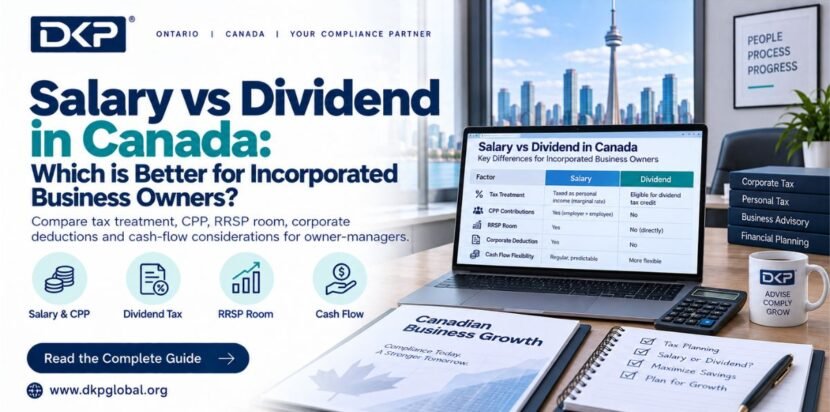
For incorporated Canadian business owners, choosing between salary and dividends is one of the most important annual tax decisions. Salary creates RRSP contribution room and CPP pension benefits but attracts payroll deductions. Dividends avoid CPP and payroll administration but do not create RRSP room. There is no universal “better” answer the optimal mix depends on your corporate tax rate, personal marginal rate, RRSP room, retirement goals, and whether you are a CCPC owner. Most Canadian tax advisors recommend a combination of salary and dividends, calibrated annually. DKP Global performs this analysis every year for incorporated clients.
In This Guide:
- 1. Why This Decision Matters for Every Incorporated Canadian Business Owner
- 2. How Salary and Dividends Are Taxed Differently
- 3. Pros and Cons of Paying Yourself a Salary
- 4. Pros and Cons of Paying Yourself Dividends
- 5. Head-to-Head Tax Comparison — Salary vs Dividend
- 6. The Integration Principle — Why Canada Designed It This Way
- 7. Eligible vs Non-Eligible Dividends — What’s the Difference?
- 8. The Optimal Mix — DKP Global’s Framework
- 9. Salary vs Dividend for Indian Immigrant Business Owners
- 10. Frequently Asked Questions (10 Q&As)
Why This Decision Matters for Every Incorporated Business Owner
When you incorporate your business in Canada, you create a legal separation between yourself and your company. The company earns income and pays corporate tax. You then decide how to extract money from the company and that decision determines your personal tax bill, your CPP pension, your RRSP contribution room, and ultimately your retirement wealth.
Most incorporated business owners make this decision by default they pay themselves whatever they need to live and call it salary, or they take everything as dividends because someone told them it is simpler. Neither approach is optimal. The salary vs dividend decision is not a one-time structural choice it is an annual optimization exercise that should be reviewed every October or November, before your fiscal year ends, with full knowledge of your corporate income for the year and your personal tax position.
The stakes are real. For a corporation earning $300,000 in active business income, the difference between a well-optimized compensation structure and a poorly chosen one can easily be $10,000–$25,000 per year in combined corporate + personal tax. Over a 10-year business lifecycle, that is $100,000–$250,000 in unnecessary tax money that could have stayed in your family’s wealth instead of going to CRA. DKP Global conducts this optimization annually for every incorporated client, calibrating the salary-dividend mix to each client’s unique financial situation.
How Salary and Dividends Are Taxed Differently
| Tax Factor | Salary | Dividend (Eligible) | Dividend (Non-Eligible) |
| Deductible by corporation? | Yes — 100% deductible against corporate income | No — paid from after-tax corporate income | No — paid from after-tax corporate income |
| Subject to CPP? | Yes — employee + employer CPP contributions required | No — dividends are not employment income | No |
| Subject to EI? | Yes (employee pays); incorporated owner-employees can opt out | No | No |
| RRSP contribution room created? | Yes — 18% of earned income (salary) up to annual limit | No — dividends are not “earned income” for RRSP | No |
| Taxed on personal T1? | Yes — as employment income at full marginal rate | Yes — with enhanced gross-up (38%) and enhanced dividend tax credit | Yes — with lower gross-up (15%) and lower dividend tax credit |
| Gross-up on T1? | No gross-up — salary reported at face value | Yes — 138% gross-up (reported as 1.38× the dividend received) | Yes — 115% gross-up (reported as 1.15× the dividend received) |
| Dividend tax credit? | N/A | Federal DTC: 15.0198% of grossed-up amount + provincial credit | Federal DTC: 9.0301% of grossed-up amount + provincial credit |
| T-slip issued? | T4 (Statement of Remuneration Paid) | T5 (Statement of Investment Income) | T5 (Statement of Investment Income) |
| Payroll administration? | Yes — CPP, EI, income tax withheld + monthly CRA remittance + T4 | No — just declare the dividend by board resolution and issue T5 | No |
Pros and Cons of Paying Yourself a Salary
Advantages of Salary
- RRSP contribution room: Salary (and other “earned income”) generates RRSP contribution room at 18% per dollar, up to the annual RRSP contribution limit ($32,490 for 2026). This is one of the most powerful wealth-building mechanisms in Canada RRSP contributions reduce your taxable income immediately at your top marginal rate, and the invested funds grow tax-free until withdrawal. No salary means no RRSP room.
- CPP pension: Salary contributions to CPP build your Canada Pension Plan retirement benefit. Each year of maximum CPP contributions adds approximately $1,306 per year to your eventual CPP retirement pension (indexed to inflation). Over a 30-year career of maximum contributions, this adds up to a significant guaranteed lifetime income. Dividends do not contribute to CPP incorporated owners who take only dividends build no CPP benefit and retire with no government pension.
- Defined deduction for corporation: Salary is 100% deductible against corporate income every dollar of salary paid reduces the corporation’s taxable income by one dollar. This directly reduces corporate tax, creating a predictable tax-planning tool.
- Employment income treatment: Salary qualifies for the basic personal amount and all personal tax credits on the T1 dividends also qualify, but salary’s interaction with credits is more straightforward.
Disadvantages of Salary
No income deferral on salary: Unlike dividends (which can be declared and paid whenever the corporation chooses), salary must be reasonable and tied to actual services rendered. You cannot declare a large retroactive salary at year end without potential CRA scrutiny for reasonableness.
Payroll administration: Salary requires a registered CRA payroll account (RP account), monthly CPP + EI + income tax remittances, T4 slips by February 28, and ROEs when employment ends. For a sole owner-employee, this is manageable DKP Global handles it. But the administrative burden is real.
CPP cost: At the time of payment, the employer also pays CPP at the same rate as the employee approximately 5.95% of salary above the basic exemption. For a $60,000 salary, the corporation pays approximately $3,400 in employer CPP in addition to the employee’s $3,400. This $6,800 combined CPP cost is partially recouped through the RRSP contribution benefit and eventual CPP pension but it is an upfront cost.
Pros and Cons of Paying Yourself Dividends
Advantages of Dividends
- No CPP: Dividends are not employment income no CPP is payable by either the corporation or the shareholder. This saves approximately $8,000 per year in combined CPP contributions at maximum earnings (2026 rates). Over 25 years, this is $200,000 in cash flow that stays with the business rather than going to CRA.
- No payroll administration: Dividends are declared by board resolution and reported on a T5 slip no payroll accounts, no monthly remittances, no ROEs. Significantly simpler than salary administration.
- Dividend tax credit: Eligible dividends paid from income taxed at the general corporate rate receive an enhanced dividend tax credit at the personal level which offsets some of the double-tax effect. For eligible dividends, the combined corporate + personal tax rate approaches the personal marginal rate on equivalent salary income.
- Timing flexibility: Dividends can be declared at any time during the year or after year end allowing the owner to time dividend payments to lower-income years, split across years for tax efficiency, or delay until retained earnings are large enough to justify.
Disadvantages of Dividends
- No RRSP room: Dividend income does not count as “earned income” for RRSP purposes. An owner who takes only dividends builds no RRSP contribution room losing access to one of Canada’s most powerful personal tax deferral mechanisms. At 50% marginal rate on $32,490 of RRSP contributions, this is a $16,245 annual personal tax deduction foregone.
- No CPP retirement benefit: Building on the “advantage” above the CPP savings today come at the cost of no government pension in retirement. For owners who will have significant corporate retained earnings as their retirement nest egg, this may be acceptable. For owners who may not accumulate sufficient corporate savings, the lack of CPP creates retirement income risk.
Non-eligible dividend tax: Dividends paid from income taxed at the small business rate are “non-eligible” dividends they receive a lower dividend tax credit than eligible dividends. The net personal tax on non-eligible dividends is higher than on eligible dividends from the same gross amount.
Head-to-Head Tax Comparison: Salary vs Dividend
Here is a concrete comparison of paying $100,000 out of a corporation in Ontario as salary vs eligible dividend vs non-eligible dividend. The corporation has already paid small business corporate tax (12.2%) on the income before the dividend.
| Comparison Point | $100,000 Salary (Ontario) | $100,000 Eligible Dividend (Ontario) | $100,000 Non-Eligible Dividend (Ontario) |
| Corporate tax on $100,000 income | $0 — salary is deductible before corporate tax | ~$12,200 corporate tax already paid (12.2% SB rate) | ~$12,200 corporate tax already paid (12.2% SB rate) |
| Net from corporation to shareholder | $100,000 gross salary | $100,000 dividend (declared from $112,200 of pre-tax income) | $100,000 dividend (declared from $112,200 of pre-tax income) |
| T1 gross-up | None — salary reported at $100,000 | 38% gross-up → $138,000 reported on T1 | 15% gross-up → $115,000 reported on T1 |
| Personal marginal rate (assume top Ontario rate 53.53%) | $53,530 personal tax | $53.53% × $138,000 = $73,871 tax before DTC | $53.53% × $115,000 = $61,560 tax before DTC |
| Dividend tax credit (federal + Ontario) | N/A | ~$27,710 DTC (federal 20.7% + Ontario 10% of grossed-up dividend) | ~$11,522 DTC (federal 9.03% + Ontario 3.12% of grossed-up amount) |
| Net personal tax payable | ~$53,530 | ~$46,161 | ~$50,038 |
| Total tax (corporate + personal) | ~$53,530 (no corporate tax) | ~$58,361 ($12,200 corp + $46,161 personal) | ~$62,238 ($12,200 corp + $50,038 personal) |
| CPP contribution (employee + employer) | ~$6,800 additional cost | $0 | $0 |
| RRSP room created | $18,000 (18% of $100,000) | $0 | $0 |
| Net cash received by owner | ~$46,470 (after $53,530 tax) | ~$53,839 (after $46,161 tax) | ~$49,962 (after $50,038 tax) |
The comparison shows eligible dividends delivering more net cash to the owner than salary BUT this ignores the $6,800 CPP contribution (which builds retirement pension and has long-term value), the $18,000 RRSP room (worth $9,000+ in immediate personal tax deduction at 50% marginal rate), and the income deferral benefit of retaining the income in the corporation at 12.2% rather than paying it all out. The numbers change significantly at different income levels, different marginal rates, and different RRSP room situations. This is precisely why DKP Global calculates a custom salary-dividend optimization for every client annually.
The Integration Principle: Why Canada Designed It This Way
The Canadian tax system is theoretically designed around the concept of “integration”, the idea that a Canadian resident should pay approximately the same total tax on business income whether they earn it personally (as a sole proprietor) or through a corporation (paying corporate tax, then taking dividends and paying personal tax). Perfect integration would mean the choice to incorporate is tax neutral.
In practice, perfect integration does not exist there are winners and losers depending on the specific income level, province, and type of income. At the small business corporate rate (11–12.2%), integration is slightly imperfect incorporated business owners who retain income in the corporation at the low rate and take it out later in lower-income years pay less combined tax than they would as sole proprietors. This is the income deferral advantage of incorporation.
For most Canadian incorporated business owners earning $150,000–$500,000, the optimal strategy is: pay yourself enough salary to maximize RRSP contributions and maintain a basic CPP benefit, then take the remainder as dividends to minimize current-year personal tax and benefit from income deferral on the balance retained in the corporation. The exact split point changes every year as income levels, RRSP room, and personal tax positions evolve which is why an annual review is not optional, it is essential.
Eligible vs Non-Eligible Dividends What’s the Difference?
| Factor | Eligible Dividend | Non-Eligible Dividend |
| Source | Paid from income taxed at the general corporate rate (15% federal + provincial) | Paid from income taxed at the small business rate (9% federal + provincial) |
| Gross-up rate on T1 | 38% — reported as 1.38× the dividend received | 15% reported as 1.15× the dividend received |
| Federal dividend tax credit | 20.7305% of grossed-up amount (15.0198% of actual dividend) | 9.0301% of grossed-up amount (10.3845% of actual dividend) |
| Provincial dividend tax credit | Varies — Ontario: 10% of grossed-up; BC: 12% of grossed-up; Alberta: no provincial DTC | Varies — Ontario: 3.12% of grossed-up; BC: 0%; Alberta: 0% |
| Net personal tax rate (Ontario top bracket) | ~33.8% effective personal rate | ~44.6% effective personal rate |
| Combined corporate + personal (Ontario) | ~47% combined — similar to personal marginal on equivalent income | ~51% combined — slightly higher than personal marginal |
| GRIP requirement | Must have sufficient General Rate Income Pool (GRIP) balance — tracked in Schedule 53 of T2 | No GRIP requirement — can always pay non-eligible dividends from SBD income |
| Best for | Corporations with income taxed at general rate — larger businesses, holding companies with investment income | Most small CCPC businesses taking dividends from SBD income — the most common type |
Most incorporated small business owners in Canada pay themselves non-eligible dividends because their corporate income is taxed at the small business rate and they do not have GRIP (General Rate Income Pool) available for eligible dividends. Non-eligible dividends still benefit from the dividend tax credit just at a lower rate than eligible dividends. Understanding which type of dividend your corporation can pay is important for accurate personal tax planning. DKP Global confirms dividend type eligibility as part of every T2 and T1 annual preparation.
The Optimal Mix: DKP Global’s Framework
There is no universal optimal salary-dividend split it depends on your specific situation. However, DKP Global’s annual compensation review follows a consistent analytical framework:
| Step | Question | Analysis |
| 1 | What is the corporation’s taxable income for the year? | Determines how much money is available for salary vs dividends before corporate tax |
| 2 | What is the owner’s personal income tax bracket? | Higher personal rate → salary less attractive; lower bracket → salary may be preferred |
| 3 | How much RRSP room does the owner have? | If RRSP room is available enough salary to maximize RRSP contribution is almost always optimal |
| 4 | Does the owner want CPP coverage? | If yes → salary at least up to the YMPE ($71,300) for maximum CPP; if no → dividends only |
| 5 | What is the owner’s personal income need (living expenses)? | Determines the minimum amount that must come out of the corporation |
| 6 | Does the owner have other income sources? | Spouse salary, rental income, investment income affects optimal personal bracket |
| 7 | Are there adult family members who are shareholders? | TOSI analysis eligible for income splitting via dividends to lower-bracket family members |
| 8 | What is the corporate tax rate? | CCPC at 12.2% vs non-CCPC at 26.5% (Ontario) — affects integration and deferral benefit |
| 9 | Calculate the optimal split | Model the combined corporate + personal tax at various salary levels — find the minimum total tax split |
| 10 | Review annually — it changes | Income levels, RRSP room, CPP position, and personal circumstances change every year |
As a practical starting point for most Ontario CCPC owners: if you have RRSP room, pay enough salary to create the maximum RRSP contribution (approximately $180,500 salary to generate $32,490 RRSP room in 2026). This salary is deductible at the corporate level and the RRSP contribution deducts it back at the personal level creating a low net personal tax cost on the salary. The remainder of your income need comes as non-eligible dividends from retained corporate earnings. The exact optimal point is always calculated by DKP Global with a full model for each client the numbers above are illustrative, not a prescription.
Salary vs Dividend for Indian Immigrant Business Owners
For Indian immigrant business owners in Canada, the salary vs dividend decision has additional dimensions that a purely Canadian perspective misses:
DTAA Withholding on Dividends Paid Abroad
If you are still an Indian resident (not yet a Canadian PR) and your Canadian corporation pays you dividends, those dividends are subject to Canadian withholding tax under the India-Canada DTAA — 25% (or 15% if you hold 10%+ of the voting shares). This withholding applies before the dividend reaches you in India. By contrast, salary paid to an Indian resident director for services rendered in Canada is subject to Canadian payroll deductions (CPP, income tax) under the normal payroll rules the DTAA tie-breaker determines which country has primary taxing rights based on the director’s physical presence in Canada.
RRSP — Relevant Only for Canadian Residents
RRSP contributions are only available to Canadian residents with contribution room. If you are an Indian resident owning a Canadian corporation remotely, salary income from the Canadian corporation does not create RRSP room for you because RRSP is a Canadian resident benefit. This removes one of the key arguments for salary over dividends for non-resident owners. Until you become a Canadian resident, the CPP savings from dividends may actually favour the dividend approach particularly since a non-resident cannot claim CPP retirement benefits without meeting specific contribution and residency thresholds.
CCPC Status and Non-Eligible Dividends
If your Canadian corporation is not a CCPC (because you are a non-resident controlling it), dividends from that corporation are paid from income taxed at the general corporate rate making them eligible dividends (if the GRIP balance supports it). This changes the dividend tax credit calculation on your Canadian T1 filing, if you are required to file one. DKP Global determines both CCPC status and dividend type eligibility for every incorporated client at year start ensuring the compensation structure is correctly modelled before the year begins.
| Need Annual Salary vs Dividend Optimization? DKP Global calculates the optimal compensation mix for incorporated Canadian business owners every year — with a full corporate + personal tax model. ACCA-UK & CS certified. 250+ businesses served. 📅 Book Free 30-Min Consultation | 📞 +1-672-833-4342 | 📧 info@dkpglobal.org | 💬 WhatsApp → DKP Global Taxation Services Canada |
Also Read- Taxation Services Canada
Also Read- T2 Corporate Tax Return Guide
Also Read- Small Business Tax Rate Canada
Also Read- Accounting and Payroll Services Canada
Also Read- CPP contributions CRA
Also Read- CRA Capital Gains Guide T4037
Also Read- Eligible dividends CRAX
Also Read- RRSP contribution room CRA
Frequently Asked Questions — Salary vs Dividend Canada
There is no single right answer — the optimal choice depends on your corporate tax rate, personal marginal rate, RRSP contribution room, retirement goals, and CPP preferences. Most incorporated Canadian business owners benefit from a combination of salary and dividends: enough salary to maximize RRSP contributions and maintain a CPP benefit, with the balance taken as dividends to minimize current-year personal tax. DKP Global models this annually for every incorporated client.
Dividends from Canadian corporations are included in personal income with a gross-up (138% for eligible dividends, 115% for non-eligible). A dividend tax credit is then applied to the grossed-up amount, partially offsetting the personal tax. The net effective personal tax rate on eligible dividends (Ontario top bracket) is approximately 33.8%; on non-eligible dividends it is approximately 44.6%. Both rates are lower than the 53.53% top rate on salary income.
For a corporation paying 12.2% (small business rate) in Ontario: salary totals approximately 53.5% personal tax with no corporate tax; non-eligible dividends total approximately 51% combined (corporate + personal). The difference is relatively small at top brackets — the bigger differences come from CPP savings on dividends vs RRSP room created by salary. At lower personal income levels, dividends are more tax-efficient. DKP Global models the precise comparison for each client annually.
Yes — salary (and other “earned income” like rental income from active involvement) creates RRSP contribution room at 18% per dollar of earned income, up to the annual RRSP limit ($32,490 for 2026). Dividends do not create RRSP room. For incorporated owners who want to maximize RRSP contributions one of Canada’s most powerful retirement tools — paying sufficient salary to generate RRSP room is usually advisable.
No dividends are not subject to CPP contributions. Only salary (employment income) generates CPP contributions and builds CPP retirement benefit. Incorporated owners who take only dividends save the annual CPP cost (~$8,000 combined employer + employee at maximum) but build no CPP retirement pension. This is a long-term trade-off: CPP savings today vs guaranteed government pension income in retirement.
Eligible dividends are paid from income taxed at the general corporate rate (15% federal + provincial) they receive a higher dividend tax credit. Non-eligible dividends are paid from income taxed at the small business rate (9% federal + provincial) they receive a lower dividend tax credit. Most CCPC small businesses pay non-eligible dividends. The corporation must have sufficient GRIP (General Rate Income Pool) balance to pay eligible dividends.