
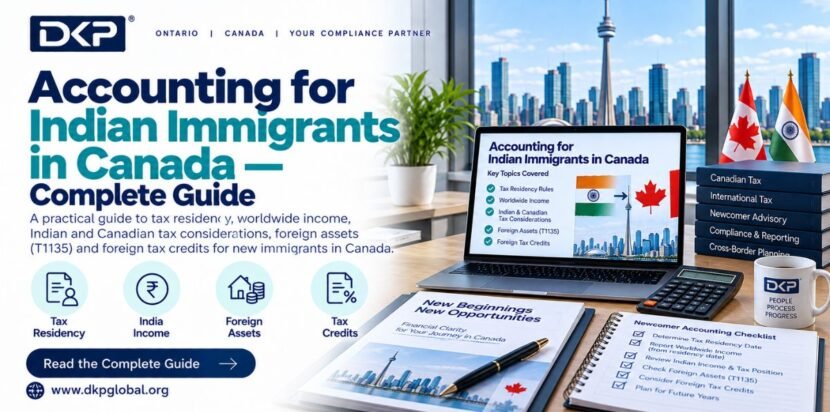
Accounting for Indian immigrants running a business in Canada involves two parallel compliance tracks: Canadian CRA obligations (bookkeeping, HST filing, T2 corporate tax return, T4 payroll) AND Indian regulatory requirements (FEMA Overseas Direct Investment compliance, Annual Performance Report to RBI, India-Canada DTAA treaty positions, and disclosure in Indian ITR). DKP Global is one of very few accounting firms in Canada that handles both tracks under one engagement with ACCA-UK Canada expertise and CA/CS India compliance knowledge.
In This Guide:
- 1. Why Indian Immigrants Need Specialized Accounting in Canada
- 2. Setting Up Your Business in Canada — Accounting Considerations
- 3. CRA Compliance for Indian Immigrant Business Owners
- 4. Canadian Bookkeeping & Tax for Indian-Owned Corporations
- 5. FEMA Compliance — Your Indian-Side Obligations
- 6. India-Canada DTAA — Avoiding Double Taxation
- 7. Indian ITR — Reporting Your Canadian Income in India
- 8. Cities — Surrey BC, Brampton ON & the Indian Business Community
- 9. Why DKP Global Is the Right Accounting Partner
- 10. Frequently Asked Questions (10 Q&As)
1. Why Indian Immigrants Need Specialized Accounting in Canada
Most accounting firms in Canada handle Canadian CRA compliance well. Most Indian CAs handle Indian income tax and FEMA well. But very few firms in Canada or in India handle both simultaneously. For an Indian immigrant or Indian resident owning a Canadian corporation, this gap is expensive.
Here is the core challenge: when you are an Indian resident (or a recent immigrant still connected to India financially) operating a Canadian company, every financial decision has two jurisdictions watching it. Pay yourself a salary from your Canadian corporation CRA wants income tax, and FEMA wants to know if any remittance crossed a border. Pay yourself a dividend Canada has a withholding tax rule under the DTAA, and India wants it declared in your ITR Schedule FA. Invest retained profits in your Canadian company the RBI wants an Annual Performance Report. Transfer money from India to fund the Canadian business LRS compliance and Form ODI required.
DKP Global was built specifically for this intersection. Our founder Dinesh Kumar Pahuja is a Company Secretary with M.Com in Indian compliance, and our Canada Operations Head Amanpreet Singh is ACCA-UK certified with on-ground Canadian experience. We handle both jurisdictions under one roof without you having to coordinate between a Canadian accountant who does not understand FEMA and an Indian CA who does not understand T2 returns.
2. Setting Up Your Business in Canada — Accounting Considerations
The accounting foundation of your Canadian business is set at incorporation. Getting it right from Day 1 avoids costly restructuring later. Here are the key decisions that affect your accounting:
| Decision | Options | Accounting Impact | DKP Recommendation |
| Province of incorporation | BC, Ontario, Alberta, Federal | BC: GST + PST separate (two filings). Ontario: HST (single filing). Alberta: GST only (simplest). | BC or Ontario for most Indian immigrants — no residency requirement for directors |
| Corporation type (CCPC vs non-CCPC) | CCPC if controlled by Canadian residents; non-CCPC if non-resident controlled | CCPC qualifies for 9% small business tax rate. Non-CCPC pays general rate (15% federal + provincial). | Optimize share structure at incorporation — DKP advises on CCPC qualification |
| Fiscal year end | Calendar year (Dec 31) or non-calendar | Calendar year simplifies Indian ITR alignment. Non-calendar can defer tax. | December 31 recommended for Indian immigrant owners — aligns with Indian April–March year for APR |
| Accounting software | Xero vs QuickBooks Canada | Both CRA-compliant. Xero recommended for Indian immigrants — multi-currency, unlimited users, cleaner interface. | Xero Standard for most Indian immigrant clients |
| Salary vs dividend mix | Salary (subject to payroll deductions) vs Dividends (no payroll) | Salary creates CPP contributions + RRSP room. Dividends avoid payroll but face DTAA withholding for non-residents. | Annual salary-dividend optimization review by DKP |
3. CRA Compliance for Indian Immigrant Business Owners
Your Canadian CRA obligations are the same as any Canadian business owner the immigration status does not change what CRA requires. Here is a quick compliance calendar:
| CRA Obligation | Frequency | Deadline | DKP Handles? |
| Monthly bookkeeping | Monthly | Ongoing — financial statements by 15th of each month | ✔ Yes |
| HST/GST return filing | Quarterly (most small businesses) | Last day of month following quarter end | ✔ Yes |
| CRA payroll remittance | Monthly | 15th of following month | ✔ Yes |
| T4 slips to employees | Annual | February 28 | ✔ Yes |
| T2 corporate tax return | Annual | 6 months after fiscal year end | ✔ Yes |
| Corporate tax payment | Annual | 3 months after fiscal year end (CCPCs) | ✔ Yes — payment planning |
| WorkSafeBC (BC) or WSIB (Ontario) | Quarterly | 15th after quarter end | ✔ Yes |
| Annual corporate return | Annual | Varies by province | ✔ Yes |
For newcomers in their first year in Canada, there are additional T1 personal tax considerations: the year of arrival T1 requires a Canadian tax return covering the period from your arrival date to December 31. Your Canadian income for the period, global income for the full year (for world income calculation), and any treaty positions under the India-Canada DTAA must all be correctly handled. DKP Global prepares first-year T1 returns for Indian immigrant business owners as part of our onboarding package.
4. Canadian Bookkeeping & Tax for Indian-Owned Corporations
Running a Canadian corporation requires the same monthly bookkeeping discipline as any Canadian business but with additional attention to cross-border transactions that have both CRA and FEMA implications.
Bookkeeping Considerations Unique to Indian-Owned Corporations
- Foreign currency transactions: If you receive income from Indian clients in INR record in Xero at the CAD equivalent on the transaction date. CRA requires all income to be reported in Canadian dollars. Xero handles multi-currency automatically.
- Inter-company transactions: If your Canadian corporation transacts with an Indian entity you own loans, service fees, management charges these are related-party transactions that require transfer pricing documentation and FEMA compliance on the Indian side.
- Capital contributions from India: If you remit funds from India to capitalize your Canadian corporation, this is an outward remittance under FEMA requiring LRS compliance and Form ODI filing before the remittance is made.
- Dividends to Indian resident shareholders: Dividends paid by the Canadian corporation to an Indian resident shareholder are subject to 25% Canadian withholding tax (or 15% under DTAA for 10%+ shareholders). Record the gross dividend, withholding tax, and net payment separately in Xero.
T2 Corporate Tax — CCPC Status for Indian Immigrant Owners
If you moved to Canada and became a Canadian resident, your corporation may qualify as a CCPC (Canadian-Controlled Private Corporation) giving you access to the 9% small business tax rate on the first $500,000 of active business income. If you are still a non-resident of Canada (Indian resident), your corporation is typically not a CCPC, and the general corporate rate applies. Residency status is a key determinant of your corporate tax rate DKP Global assesses this at incorporation and annually.
5. FEMA Compliance — Your Indian-Side Obligations
The Foreign Exchange Management Act (FEMA) governs how Indian residents can invest abroad. If you are an Indian resident owning a Canadian corporation, you have ongoing FEMA compliance obligations on the Indian side. These are in addition to your CRA obligations not instead of them.
| FEMA Obligation | When Required | Filing / Compliance Required | Penalty for Non-Compliance |
| Form ODI — Overseas Direct Investment | Before first remittance from India to Canadian corporation | File Form ODI with your Indian AD (Authorized Dealer) bank before remitting funds — declare investment in Canadian company | Up to 3x the amount invested, imprisonment up to 3 years (FEMA penalty) |
| Annual Performance Report (APR) | Every year — due March 31 | File APR with RBI (via AD bank) showing Canadian corporation’s audited financials for the year | Penalty + compounding interest — RBI can freeze further overseas remittances |
| Form FC-TRS (share transfer) | When shares of Canadian corporation are transferred | Report any change in shareholding to AD bank | Penalty for unreported share transfers |
| LRS — Liberalised Remittance Scheme | For outward remittances from India | Each remittance from India (capital, loans, operational funding) must comply with LRS limit ($250,000 per year per individual) | Remittances above LRS limit without RBI approval are FEMA violations |
| Form A2 | For each outward remittance | Fill Form A2 with your Indian bank for each remittance — purpose code, beneficiary details, amount | Bank blocks non-compliant remittances — delays business operations |
DKP Global prepares the Canadian audited financial statements required for the APR, coordinates with your Indian CA for the RBI filing, and advises on Form ODI structure at incorporation. We are one of the very few firms in Canada that understands FEMA well enough to integrate it with Canadian accounting compliance.
6. India-Canada DTAA — Avoiding Double Taxation
The India-Canada Double Taxation Avoidance Agreement (DTAA) is a treaty between the two countries that determines which country has taxing rights on various types of income and at what rate. For Indian immigrant business owners, the DTAA is the key document that prevents your income from being taxed twice.
| Income Type | Canada’s Taxing Right | India’s Taxing Right | DTAA Withholding Rate | Practical Implication |
| Business profits of Canadian corporation | Yes — corporate tax at 11–27% | No (if no Indian PE) | N/A | Canada taxes the corporation. India does not tax corporate profits unless there is a Permanent Establishment in India. |
| Dividends paid to Indian resident shareholder | Yes — withholding tax | Yes — as Indian income of the shareholder | 25% Canadian withholding (15% if 10%+ shareholding) | Canadian corporation withholds 25% (or 15%) on dividends. Net dividend received in India is then declared in Indian ITR — DTAA credit claimed for Canadian withholding. |
| Interest on loans from Canada to India | Yes — Canadian withholding | Yes — Indian income | 15% Canadian withholding | If Canadian company lends to Indian entity — 15% withholding applies. |
| Royalties and technical service fees | Yes — Canadian withholding | Yes — Indian income | 15% Canadian withholding | If Canadian company pays royalties to Indian IP holder — 15% withholding. |
| Capital gains on sale of Canadian shares | Depends on type of property | India may also tax as Indian income | Case-specific — treaty tie-breaker applies | Immovable property in Canada: Canada taxes. Shares: complex — treaty analysis required. DKP advises case-by-case. |
| Salary of Indian resident working in Canada | Canada taxes if working in Canada | India taxes global income of residents | Tie-breaker rules apply | Indian resident working temporarily in Canada: both countries claim taxing rights — DTAA tie-breaker determines primary right. |
The DTAA does not eliminate double taxation automatically you must actively claim treaty benefits in both countries. In Canada, you file the T2 and pay Canadian corporate tax. In India, you claim a DTAA credit in your ITR for the Canadian taxes paid. DKP Global advises on DTAA positions for every cross-border income event and coordinates the documentation needed to claim DTAA relief in both jurisdictions.
7. Indian ITR — Reporting Your Canadian Income in India
If you are an Indian resident (not yet a Canadian PR or citizen), your global income including income from your Canadian corporation — must be reported in your Indian Income Tax Return. Here is what must be disclosed:
- Schedule FA (Foreign Assets): Your shares in the Canadian corporation must be declared in Schedule FA of your Indian ITR — with the acquisition cost, year of acquisition, and current value in INR.
- Schedule FSI (Foreign Source Income): Dividends received from the Canadian corporation, salary paid by the Canadian corporation, and any other income from Canadian sources must be disclosed in Schedule FSI.
- Schedule TR (Tax Relief): Canadian taxes paid (corporate tax withheld on dividends, income tax on salary) must be claimed as DTAA relief in Schedule TR — offsetting the Indian tax liability on the same income.
- FBAR equivalent: India does not have a direct FBAR (US Foreign Bank Account Report) equivalent, but Schedule FA requires disclosure of all foreign bank accounts held by the Indian resident including your Canadian business bank account.
Failure to disclose foreign assets in Schedule FA is a serious offence under the Black Money Act 2015 in India penalties can be up to 300% of the undisclosed amount. DKP Global coordinates with your Indian CA to ensure complete Schedule FA disclosure using the correct values from your Canadian Xero/QuickBooks records.
8. Cities — Surrey BC, Brampton ON & the Indian Business Community
Surrey, British Columbia — DKP Global’s Canada HQ
Surrey BC has the largest South Asian community in Canada over 120,000 residents of South Asian origin. It is DKP Global’s Canada base (+1-672-833-4342), and the city where we serve the largest concentration of Indian immigrant business owners. Surrey businesses incorporate under the BC Business Corporations Act no Canadian resident director required, same-day incorporation, and no annual report fee. BC GST (5%) + PST (7%) dual compliance applies. WorkSafeBC registration before first hire.
Brampton, Ontario — Largest Indian Community in Ontario
Brampton has the highest concentration of Indian residents in Ontario a growing hub for Indian-origin entrepreneurs in transportation, logistics, retail, and professional services. Ontario corporations benefit from no Canadian resident director requirement (since 2023) and HST at 13% (single combined filing simpler than BC’s split tax). DKP Global serves Brampton and Mississauga clients remotely from our Noida India office and Canada presence.
Vancouver, Burnaby & Richmond, BC
Vancouver and surrounding municipalities (Burnaby, Richmond, Coquitlam) host a large Punjabi and South Indian community, particularly in technology, real estate, and professional services. BC incorporation applies same advantages as Surrey. DKP Global serves Vancouver-area clients 100% remotely.
Calgary, Alberta — Growing Indian Entrepreneur Hub
Calgary’s Indian community is growing rapidly, particularly in IT, engineering, and healthcare. Alberta has the lowest corporate tax rate in Canada (combined 11% small business rate) and no provincial sales tax the simplest tax environment for new business owners. DKP Global serves Calgary clients remotely.
9. Why DKP Global Is the Right Accounting Partner for Indian Immigrants
| What DKP Global Offers | Why It Matters for Indian Immigrant Business Owners |
| ACCA-UK certified Canada Operations Head (Amanpreet Singh) | Your Canadian accounting is handled by a qualified professional who understands both Canadian regulations and the Indian business background you are coming from |
| CS + M.Com certified Indian compliance expertise (Dinesh Pahuja) | Your Indian-side obligations FEMA, ITR Schedule FA, DTAA are handled by a qualified Company Secretary, not a generalist accountant |
| India-Canada DTAA advisory in one engagement | No need to coordinate between a Canadian accountant who doesn’t know FEMA and an Indian CA who doesn’t know T2 DKP handles both |
| FEMA Form ODI and APR preparation | We prepare the Canadian audited financials needed for your RBI APR and coordinate with your Indian bank/CA for filing |
| BC and Ontario incorporation specialists | We know BC Business Corporations Act, OBCA, and Canadian incorporation nuances including the no-residency-director rules ideal for Indian immigrants |
| 100% remote service | All bookkeeping, tax filing, and compliance delivered digitally you never need to visit our office regardless of where you are in India or Canada |
| Xero + QuickBooks certified | We set up your cloud accounting from Day 1 you have 24/7 real-time access to your Canadian financials from anywhere in the world |
| Fixed-fee pricing — no surprise bills | Know your monthly accounting cost upfront important for new business owners managing tight startup budgets |
| 250+ businesses served across India, Canada, USA | Proven track record not a startup firm learning as they go |
The Indian immigrant business community in Canada is one of the fastest-growing entrepreneurial segments in the country. From Surrey to Brampton to Calgary, Indian entrepreneurs are building businesses that span both economies. The accounting complexity they face managing CRA on one hand and FEMA/RBI on the other is real, and the cost of getting it wrong in either jurisdiction is significant. DKP Global exists to make this dual compliance manageable and to give Indian immigrant entrepreneurs the same professional accounting support that large corporations take for granted.
| Accounting for Your Indian-Owned Canadian Business?DKP Global handles both your Canadian CRA compliance (bookkeeping, HST, T2, payroll) AND Indian FEMA obligations (Form ODI, APR, DTAA advisory) under one engagement. ACCA-UK + CS certified. 100% remote.📅 Book Free 30-Min Consultation | 📞 +1-672-833-4342 | 📧 info@dkpglobal.org | 💬 WhatsApp→ DKP Accounting & Payroll Services in Canada |
Also Read- accounting and payroll services Canada
Also Read- company registration in Canada
Also Read- bookkeeping for small business Canada
Also Read- T2 corporate tax return Canada
Also Read- CRA payroll remittance Canada
Also Read- CRA guide for newcomers to Canada
Also Read- FEMA Overseas Direct Investment RBI
Also Read- India-Canada DTAA text
Frequently Asked Questions – Accounting for Indian Immigrants in Canada
Q1: Do Indian immigrants need to file taxes in both Canada and India?
It depends on your residency status. If you are a Canadian resident (PR or citizen), Canada taxes your worldwide income and India does not (unless you have Indian-source income). If you are still an Indian resident owning a Canadian corporation, India taxes your global income including dividends or salary from the Canadian company and you must disclose the Canadian corporation in Schedule FA of your Indian ITR. The India-Canada DTAA prevents double taxation through credit mechanisms in both countries.
Q2: Can an Indian immigrant own 100% of a Canadian corporation?
Yes BC and Ontario allow 100% foreign ownership of provincial corporations with no Canadian resident director requirements. Federal CBCA corporations require 25% Canadian resident directors. For Indian immigrants who are not yet Canadian residents, BC or Ontario Provincial incorporation is the recommended choice DKP Global handles incorporation for both residents and non-residents of Canada.
Q3: What is FEMA and why does it apply to Indian immigrants in Canada?
FEMA (Foreign Exchange Management Act) is the Indian law governing how Indian residents can hold foreign assets and make cross-border transactions. If you are an Indian resident owning a Canadian corporation or Canadian bank account, FEMA requires you to report the investment via Form ODI before remitting funds, file an Annual Performance Report (APR) with RBI every March 31, and comply with the Liberalised Remittance Scheme (LRS) for all outward remittances. Becoming a Canadian PR or citizen changes your FEMA status DKP Global advises on the transition.
Q4: What is the India-Canada DTAA and how does it help Indian immigrant business owners?
The India-Canada Double Taxation Avoidance Agreement is a bilateral tax treaty that determines which country has taxing rights on various types of income and at what withholding rate. For Indian immigrants, the DTAA prevents the same income from being taxed in both India and Canada. For example, dividends paid from your Canadian corporation to an Indian resident are subject to 25% Canadian withholding (or 15% if you hold 10%+) but you can claim this as a foreign tax credit in your Indian ITR, avoiding double taxation.
Q5: What is Form ODI and when must I file it?
Form ODI (Overseas Direct Investment) is an RBI form that Indian residents must file with their Authorized Dealer (AD) bank before investing in a foreign entity including a Canadian corporation. It must be filed before the first remittance from India to the Canadian company. After filing Form ODI, you must also file an Annual Performance Report (APR) every March 31 attached to audited financial statements of the Canadian corporation. DKP Global prepares the Canadian financials needed for the APR.
Q6: Does my Canadian corporation income need to be declared in my Indian ITR?
Yes if you are an Indian resident. As a resident of India, you must declare your global income in your Indian ITR (Income Tax Return). This includes: dividends received from your Canadian corporation (Schedule FSI), salary paid by the Canadian corporation (Schedule FSI), your shares in the Canadian corporation as a foreign asset (Schedule FA), and your Canadian business bank account (Schedule FA). Failure to disclose foreign assets carries severe penalties under the Black Money Act 2015.
Q7: What accounting software does DKP Global recommend for Indian immigrant business owners in Canada?
DKP Global recommends Xero Canada for most Indian immigrant business owners it is more intuitive for non-accountants, supports multi-currency (CAD/INR) natively, allows unlimited user access (including your Indian CA or family members), and integrates with Hubdoc for digital receipt scanning. Xero’s cloud-based platform means you can access your Canadian financials from anywhere in India or Canada 24/7.
Q8: Can I run a Canadian corporation while living in India?
Yes BC and Ontario Provincial Corporations have no Canadian resident director requirements. You can incorporate, own, and operate a Canadian corporation 100% remotely from India. You will need a Canadian registered office address (DKP Global provides this), a Canadian business bank account (some banks offer remote opening for non-residents), and CRA compliance managed remotely (DKP Global handles all of this). FEMA Form ODI must be filed before remitting funds from India.