

Canada India DTAA Complete Guide for Indian Business Owners 2026
The India-Canada Double Taxation Avoidance Agreement (DTAA) is a bilateral tax treaty that determines which country taxes specific types of cross-border income and at what withholding rate. Key DTAA withholding rates: dividends 25% (15% if 10%+ shareholding), interest 15%, royalties 15%. The DTAA prevents the same
Read More
SR&ED Tax Credit Canada How to Claim R&D Credits 2026
The SR&ED (Scientific Research & Experimental Development) program is Canada’s largest federal tax incentive providing Investment Tax Credits (ITCs) of up to 35% refundable on qualifying R&D expenditures for CCPCs. For CCPCs, the first $3 millions of qualifying expenditures receives a 35% refundable ITC meaning CRA
Read More
Salary vs Dividend in Canada: Which is Better for Incorporated Business Owners?
For incorporated Canadian business owners, choosing between salary and dividends is one of the most important annual tax decisions. Salary creates RRSP contribution room and CPP pension benefits but attracts payroll deductions. Dividends avoid CPP and payroll administration but do not create RRSP room. There is
Read More
Capital Gains Tax Canada — What Business Owners Must Know
Capital gains tax in Canada applies when you sell an asset for more than you paid for it. In 2026, individuals pay tax on 50% of capital gains (the inclusion rate) — this taxable portion is added to income and taxed at your marginal personal rate.
Read More
Accounting for Indian Immigrants in Canada — Complete Guide
Accounting for Indian immigrants running a business in Canada involves two parallel compliance tracks: Canadian CRA obligations (bookkeeping, HST filing, T2 corporate tax return, T4 payroll) AND Indian regulatory requirements (FEMA Overseas Direct Investment compliance, Annual Performance Report to RBI, India-Canada DTAA treaty positions, and disclosure
Read More
Xero vs QuickBooks Canada – Which is Better for Small Business?
Xero and QuickBooks Online are the two leading cloud accounting platforms for Canadian small businesses. Both support HST/GST tracking, Canadian bank feeds, payroll, and CRA compliance. Xero is better for service businesses and non-accountants cleaner interface, easier bank reconciliation. QuickBooks Online Canada is better for retail,
Read More
HST Filing Canada — Step-by-Step Guide for Businesses 2026
HST (Harmonized Sales Tax) filing in Canada involves calculating net tax total HST collected from customers minus Input Tax Credits (ITCs) for HST paid on business purchases and remitting the balance to CRA. The HST return (GST34) is filed online via CRA My Business Account. Filing
Read More
T2 Corporate Tax Return Canada | Complete Guide 2026
The T2 Corporation Income Tax Return is the annual tax return filed by all Canadian corporations including inactive ones. The T2 is due 6 months after the corporation’s fiscal year end. Tax is due 3 months after year end (2 months for non-CCPCs). The federal small
Read More
Payroll Deductions Canada — CPP | EI | Income Tax Explained
Canadian payroll deductions consist of three mandatory source deductions withheld from every employee’s pay: CPP (Canada Pension Plan) contributions at 5.95% of pensionable earnings, EI (Employment Insurance) premiums at 1.66% of insurable earnings, and federal + provincial income tax based on TD1 claim codes and CRA
Read More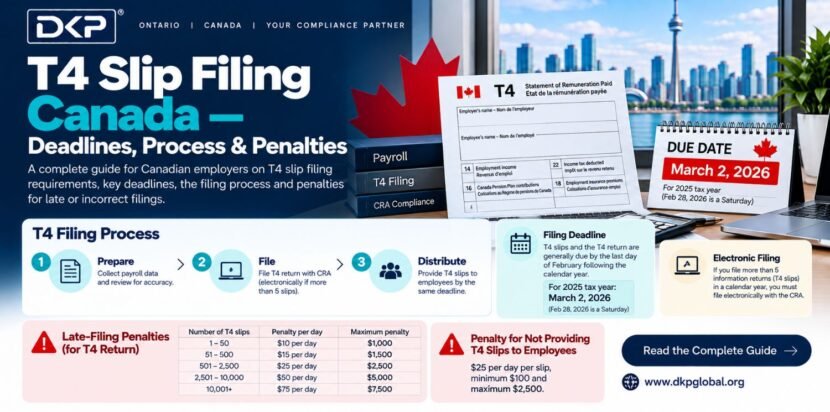
T4 Slip Filing Canada — Deadlines, Process & Penalties 2026
A T4 slip (Statement of Remuneration Paid) is the Canadian equivalent of a W-2 every employer must issue a T4 to each employee and file a T4 Summary with CRA by February 28 each year (February 29 in leap years). T4 slips report total employment income
Read More